

Request Method
WebSocketEndpoint
wss://api.stepfun.ai/v1/realtime/audio
For Step Plan, use
wss://api.stepfun.ai/step_plan/v1/realtime/audioRequest Headers
Authorizationstringrequired The API key used for authentication. Its value should be:Bearer YOUR_STEP_API_KEY.
Request Body
modelstringrequired The name of the model to use. Currently supportsstepaudio-3-ttsandstepaudio-2.5-tts.
The
step-tts-vivid model name is deprecated but existing user requests will continue to be supported.Call Instructions
To generate audio in streaming mode, you must send the corresponding Client Event after the WebSocket connection is successfully established. The server will then return the corresponding Server Event, through which the audio is generated. If there is no activity for 60 consecutive seconds, the system will automatically close the connection.Client Event & Server Event Mapping
A detailed description can be found in the explanation below.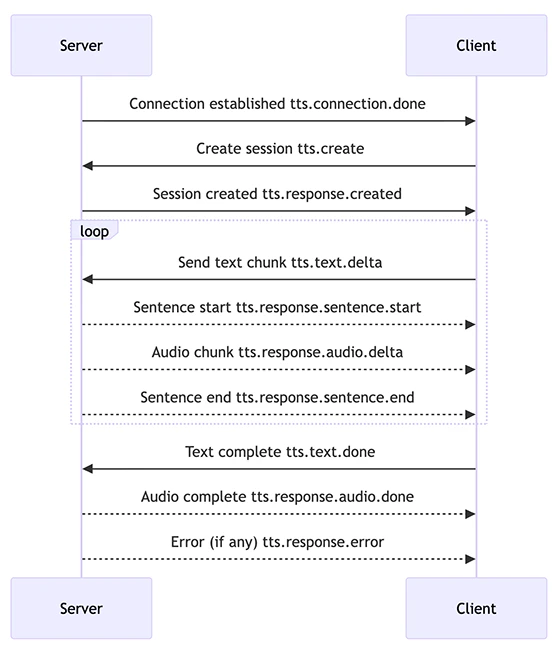
Client Event Details
Create Session tts.create
The event used to create a new session. After the WebSocket connection is established and the tts.connection.done Server Event is received, the client should send this event to initiate audio generation.
typestringrequired Must be set totts.create.dataobjectrequired Event payload.session_idstringrequired The session ID used to identify which conversation the request belongs to. Returned by thetts.connection.doneServer Event.voice_idstringrequired The ID of the voice to use. Refer to the System Voice ID List for supported voices and samples.languagestringoptional Target language; defaults to English when omitted. Supported values:zh,en,ja,ko,fr,es. Japanese, Korean, French, and Spanish are in preview.response_formatstringoptional The audio format. Supported values are:wav,mp3,flac,opus,pcm. Also supports streaming variants:mp3_stream,opus_stream,flac_stream. Defaults tomp3.sample_rateintoptional The sampling rate of the output audio. Supported values:8000,16000,22050,24000,48000. Default:24000.pronunciation_mapobject arrayoptional Defines a pronunciation rule to annotate or override the reading of specific characters or symbols. In Chinese text, tones are represented by numbers: 1 for the first tone, 2 for the second tone, 3 for the third tone, 4 for the fourth tone, and 5 for the neutral tone.tonestringrequired Specific pronunciation mapping rules, separated by/. Example:["omg/oh my god"].
speed_ratiofloatoptional The speaking rate. Valid range: 0.5 to 2.0. Default: 1.0.volume_ratiofloatoptional The volume level. Valid range: 0.1 to 2.0. Default: 1.0.modestringoptional The generation mode. Supported values:default(character-level generation, suitable for LLM real-time streaming scenarios) andsentence(sentence-level generation, suitable when full sentences are already prepared). Default:default.instructionstringoptional Global natural language guidance. Only effective when connected to thestepaudio-2.5-ttsorstepaudio-3-ttsmodel. Used to set the overall emotional tone for the session. Maximum length: 200 characters forstepaudio-2.5-tts, 500 characters forstepaudio-3-tts.markdown_filterbooloptional Whether to enable Markdown filtering for the input text.
tts.text.flush, and the model will promptly return the available audio.
Sentence mode is suitable for scenarios where the full text is already available. In this mode, the system automatically segments the text based on punctuation marks such as . ! ? and generates audio accordingly.
Example:
Generate Audio tts.text.delta
Client Event used to generate audio. During generation, if the TTS engine determines that the conditions for audio generation have been met, it returns a tts.response.sentence.start event to indicate that inference has begun. It then returns one or more tts.response.audio.delta events containing the audio data. After all audio for the sentence has been sent, the engine returns a tts.response.sentence.end event to indicate that the sentence has finished generating.
If the TTS engine determines that the conditions have not been met, no events will be returned.
typestringrequired Must be set totts.text.delta.dataobjectrequired Event payload.session_idstringrequired The session ID used to identify which conversation the request belongs to. Returned by thetts.connection.doneServer Event.textstringrequired The text to be synthesized. The maximum length is 1,000 characters. When usingstepaudio-2.5-ttsorstepaudio-3-tts, supports using()to pass non-spoken inline instructions. If the text itself needs to be spoken, do not wrap it in parentheses.
Flush Buffer tts.text.flush
Forces the TTS engine to return all audio generated so far by clearing the internal buffer.
typestringrequired Must be set totts.text.flush.dataobjectrequired Event payload.session_idstringrequired The session ID used to identify which conversation the request belongs to. Returned by thetts.connection.doneServer Event.
Finish Audio Generation tts.text.done
Complete Audio Generation.
typestringrequired Must be set totts.text.done.dataobjectrequired Event payload.session_idstringrequired The session ID used to identify which conversation the request belongs to. Returned by thetts.connection.doneServer Event.
Server Event Details
Connection Established tts.connection.done
Indicates that the WebSocket connection has been successfully established.
event_idstringrequired The unique ID of this event. When contacting support, providing this ID helps with troubleshooting.typestringrequired Must be set totts.connection.done.dataobjectrequired Event payload.session_idstringrequired The session ID that must be included in subsequent requests.
Session Created tts.response.created
Indicates that the session has been successfully created.
event_idstringrequired The unique ID of this event. When contacting support, providing this ID helps with troubleshooting.typestringrequired Must be set totts.response.created.dataobjectrequired Event payload.session_idstringrequired The session ID that must be included in subsequent requests.
Sentence Start tts.response.sentence.start
Indicates that the TTS engine has begun generating a new sentence.
event_idstringrequired The unique ID of this event. When contacting support, providing this ID helps with troubleshooting.typestringrequired Must be set totts.response.sentence.start.dataobjectrequired Event payload.session_idstringrequired The session ID for the current conversation.textstringrequired The text content being generated in this sentence.request_idstringrequired The identifier for this generation turn, formatted as<session_id>-tts.<id>. Use it to correlate this sentence with itstts.response.sentence.end(and, when subtitles are available, its subtitle event).timestampintegerrequired Event timestamp, in milliseconds.
Receive Generated Audio tts.response.audio.delta
Indicates that the server is returning a chunk of generated audio.
event_idstringrequired The unique identifier of this event. When contacting support, providing this ID helps with troubleshooting.typestringrequired Must be set totts.response.audio.delta.dataobjectrequired Event payload.session_idstringrequired The session ID must be used in subsequent requests.statusstringrequired The generation status. Supported values areunfinishedandfinished.audiostringrequired The Base64-encoded audio data.durationfloatrequired The duration of this audio chunk, in seconds.
Sentence End tts.response.sentence.end
Indicates that the TTS engine has finished generating a sentence.
event_idstringrequired The unique identifier of this event. When contacting support, providing this ID helps with troubleshooting.typestringrequired Must be set totts.response.sentence.end.dataobjectrequired Event payload.session_idstringrequired The session ID.textstringrequired The text content generated for this sentence.request_idstringrequired The identifier for this generation turn, formatted as<session_id>-tts.<id>. Matches therequest_idof the correspondingtts.response.sentence.start.timestampintegerrequired Event timestamp, in milliseconds.
Flush Start tts.text.flushed
Indicates that the system has received the flush command and has begun clearing the buffer.
event_idstringrequired The unique identifier of this event. When contacting support, providing this ID helps with troubleshooting.typestringrequired Must be set totts.text.flushed.dataobjectrequired Event payload.session_idstringrequired The session ID that must be included in subsequent requests.
Generation Completed tts.response.audio.done
Indicates that the audio generation task has been completed. After receiving this event, the connection will automatically close. Additionally, if the connection remains idle for more than 60 seconds, the system will also complete the generation and close the connection.
event_idstringrequired The unique identifier of this event. When contacting support, providing this ID helps with troubleshooting.typestringrequired Must be set totts.response.audio.done.dataobjectrequired Event payload.session_idstringrequired The session ID that must be included in subsequent requests.audiostringrequired The Base64-encoded audio data, containing all audio content generated in this session.
Error Event tts.response.error
Indicates that an error occurred during audio generation.
Code Example
First, runpip install websocket-client, and then execute the following code.
stepaudio-2.5-tts Code Example (Python)
First, runpip install websocket-client, and then execute the following code.